 Tech Exec Insight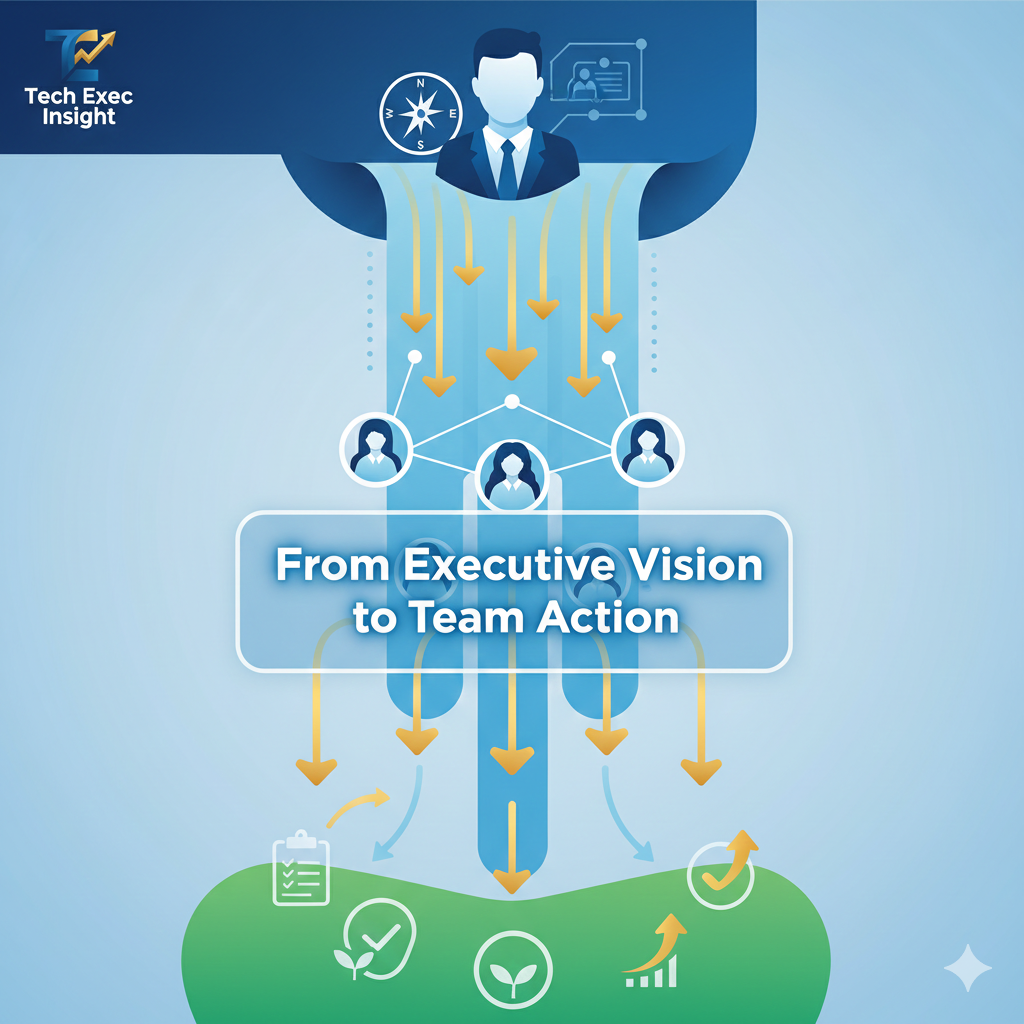
Cascading Strategy to Your Team
How to translate executive vision into actionable goals your team understands and embraces
The CEO just announced a major strategic shift: "We're pivoting from B2B to B2C." You understand what this means for technology architecture, customer data models, and product features. Now you need to communicate this to your engineering team in a way that's clear, motivating, and actionable.
Here's the problem: Strategy gets lost in translation. Executives speak in market dynamics and competitive positioning. Your team thinks in features, APIs, and sprint goals. Your job as an engineering leader is to be the translator—to cascade strategy from high-level vision to concrete technical work while maintaining clarity, motivation, and alignment.
The key is adapting your communication style to how your team learns. Here's how to do it effectively.
Understanding the Team Communication Challenge
When cascading strategy to your team, you're navigating three simultaneous challenges:
The Three Translation Challenges
- Context Gap: Your team wasn't in the executive meeting. They don't know the "why" behind strategic decisions.
- Abstraction Gap: Executive strategy is high-level ("improve customer experience"). Teams need specific actions ("reduce checkout latency from 2.3s to under 1s").
- Motivation Gap: Teams want to understand how their work matters. Abstract strategy doesn't inspire; concrete impact does.
Your goal: Bridge all three gaps using communication methods that match how your team members learn.
The Four Learning Styles for Team Communication
Visual Team Members
How they process information: Through diagrams, roadmaps, and visual connections between strategy and execution. They need to "see" how pieces fit together.
Communication Strategies:
1. Create Team Roadmaps
Visual timeline showing company goal → department goal → team deliverables:
Example: Cascading "Improve Customer Retention" Strategy
Visual Roadmap (single page):
- Company Goal (Top): Increase customer retention from 82% to 90% by Q4
- ↓ Product Strategy: Reduce friction in onboarding and improve core feature performance
- ↓ Engineering Strategy:
- Platform Team: Improve API response times
- Mobile Team: Simplify onboarding flow
- Data Team: Build churn prediction model
- ↓ Your Team's Focus (Q1-Q2):
- Q1: Reduce checkout API latency from 2.3s to 1.0s
- Q1: Implement caching layer for product catalog
- Q2: Add real-time search with autocomplete
- Q2: Optimize database queries (top 10 slow queries)
- ↓ Expected Impact: 15% improvement in purchase completion rate, 8-point NPS lift
2. Build OKR Trees
Show how team objectives ladder up to company OKRs:
- Level 1 (Company OKR): Increase annual revenue from $50M to $75M
- Level 2 (Product OKR): Increase average order value by 25%
- Level 3 (Engineering OKR): Improve recommendation engine conversion by 30%
- Level 4 (Your Team KRs):
- Deploy ML-based recommendation model to production
- Achieve 200ms p95 latency for recommendation API
- A/B test shows 30%+ click-through improvement
3. Draw Dependency Maps
Visual showing which teams you depend on and which teams depend on you:
Example: Platform Modernization Dependency Map
Your Team (Center): Core Services Team
Dependencies (We need from them):
- Infrastructure Team → Kubernetes cluster ready by March 1
- Security Team → OAuth implementation by March 15
Downstream (They need from us):
- Mobile Team → New API endpoints by April 1
- Web Team → GraphQL gateway by April 15
Critical Path Highlighted: If Infrastructure is late, entire timeline shifts right. Team sees this visually.
4. Create "Impact Dashboards"
Show how team work affects customer metrics in real-time:
- API latency graph with customer conversion overlay
- Deployment frequency timeline with revenue trend line
- Error rate chart with customer satisfaction scores
What to Avoid:
- Verbal-only strategy presentations without visuals
- Abstract goals without visual connection to team work
- Complex Gantt charts—use simple timelines instead
Auditory Team Members
How they process information: Through discussion, storytelling, and verbal context. They need to hear the "why" narrative.
Communication Strategies:
1. Host Town Halls
Let team hear directly from leadership, then cascade with your team-specific context:
Example: Cascading Company Pivot
Step 1: Attend Company All-Hands where CEO explains market shift
Step 2: Host Team Meeting (30 min):
- Minutes 1-5: Recap CEO's message in your own words, emphasizing key points
- Minutes 6-15: "Here's what this means for us specifically..." Translate strategy into team implications
- Minutes 16-25: Open Q&A—let team voice concerns and ask questions
- Minutes 26-30: "Here are our next steps..." Concrete actions starting this sprint
2. Tell the "Why" Story
Explain market shifts, customer feedback, and competitive pressure that drive strategy:
Example: Explaining Architecture Modernization
"Let me tell you what happened last quarter. Marketing wanted to run a flash sale for Black Friday. Simple, right? Just update pricing and turn on the promotion.
But our system couldn't handle it. The pricing service is tightly coupled to inventory, which is coupled to checkout, which is coupled to everything else. Changing pricing meant deploying the entire monolith. Three weeks of regression testing. We missed Black Friday entirely. Marketing estimates we lost $1.2M in revenue.
Now imagine next quarter. We have a new competitor undercutting us on price. Sales needs to react instantly. But we're stuck with our 3-week deployment cycle. We can't compete.
That's why we're modernizing our architecture. Not because microservices are trendy. Because our current system is costing us $1M+ per quarter in missed opportunities and making us too slow to compete. Your work on breaking apart the monolith directly enables the company to move faster than competitors. That's the mission."
3. Open Q&A Sessions
Auditory learners process through discussion. Create space for it:
- Weekly office hours: "Bring your questions about our strategy and priorities"
- Post-announcement Q&A: After any major strategic shift, schedule open forum
- Anonymous question box: Collect questions async, answer in group setting
4. Repeat Key Messages
Strategy doesn't stick the first time. Repeat it in multiple contexts:
- Sprint planning: "Remember, we're focused on performance because it drives retention..."
- 1-on-1s: "Your work on caching directly supports our Q2 goal of..."
- Retrospectives: "This sprint we improved latency by 40%, which aligns with..."
- Demo days: "This feature demonstrates our commitment to..."
What to Avoid:
- Sending strategy emails without verbal discussion
- Assuming one announcement is enough
- Skipping the "why" and jumping straight to "what"
Reading/Writing Team Members
How they process information: Through written documentation, detailed memos, and text-based context. They want something to reference and digest.
Communication Strategies:
1. Write Strategy Memos
Document the context, decision, and implications:
Team Strategy Memo Template
Section 1: Context (What's Changing and Why)
- Market dynamics or competitive pressure
- Customer feedback or business need
- Executive decision and rationale
Section 2: What This Means for Our Team
- Our specific focus areas for next 2-3 quarters
- What we're starting, stopping, continuing
- Success metrics and how we'll measure
Section 3: How We'll Execute
- Key milestones and timeline
- Team structure or role changes
- Dependencies and cross-team coordination
Section 4: FAQ
- Anticipated questions with answers
- What's uncertain and when we'll know more
2. Create Team Charter Documents
Written mission, vision, and operating principles:
Example: Platform Team Charter
Mission: Provide scalable, reliable infrastructure that enables product teams to ship features 10x faster
Vision (3 years): All product teams deploy independently multiple times per day with 99.95% reliability and zero infrastructure dependencies
Core Principles:
- Developer Experience First: If it's hard to use, we haven't finished
- Reliability is Non-Negotiable: We don't ship until it's tested at scale
- Automation Over Documentation: Solve problems with code, not runbooks
- Ship Incrementally: Small, frequent releases beat big bang deployments
What Success Looks Like (This Year):
- Product team deployment frequency: 1/day → 5/day
- Platform reliability: 99.2% → 99.9%
- Infrastructure cost: $800K/mo → $550K/mo
- Onboarding time for new services: 2 weeks → 1 day
3. Maintain Decision Logs
Document major strategic and technical decisions with rationale:
| Date | Decision | Context | Rationale | Impact |
|---|---|---|---|---|
| Jan 15, 2026 | Adopt Kubernetes | Need container orchestration for microservices | Industry standard, mature ecosystem, team has experience | Q1-Q2 migration, all new services K8s-native |
| Jan 22, 2026 | Pause feature work for technical debt | Deployment time increased to 3 weeks, outages up 40% | Can't scale current system, technical debt blocking velocity | 20% of Q1 capacity allocated to refactoring |
| Feb 5, 2026 | Standardize on PostgreSQL | Currently running 4 different databases | Reduce operational complexity, team expertise, cost efficiency | Migrate Redis use cases to Postgres by Q2 |
4. Create Reference Documentation
Living documents team can reference:
- Quarterly roadmap: Updated monthly with progress
- Team objectives: OKRs with weekly key result tracking
- Architecture decision records (ADRs): Why we chose specific technical approaches
- Meeting notes repository: All strategic discussions documented
What to Avoid:
- Verbal-only communication without written follow-up
- Decisions made in meetings without documentation
- Outdated documentation—if it's written, keep it current
Kinesthetic Team Members
How they process information: Through hands-on work, experimentation, and tangible results. They learn by doing.
Communication Strategies:
1. Run Strategy Workshops
Let team brainstorm how to execute strategy rather than dictating approach:
Example: Workshop for "Improve Developer Experience"
Setup (2-hour workshop):
- Phase 1 (30 min): Present the goal: "Reduce time from PR to production from 3 hours to 30 minutes"
- Phase 2 (45 min): Teams brainstorm on whiteboards: "What's slowing us down?" Groups identify: manual testing, deployment approvals, environment setup
- Phase 3 (30 min): Vote on top 3 improvements to tackle first
- Phase 4 (15 min): Form working groups to prototype solutions next sprint
Result: Team owns the solution because they designed it
2. Create Working Groups
Hands-on exploration of new strategic direction:
- Spike teams: "Take one sprint to explore AI-powered code review. Report back what's possible."
- Tiger teams: "Form a group to prototype the new architecture. Show us a working demo in 3 weeks."
- Innovation sprints: "20% time this quarter: experiment with technologies that support our strategic goals"
3. Prototype First, Plan Second
Let teams build proof-of-concepts before committing to long-term plans:
Example: Migrating to Event-Driven Architecture
Wrong: Announce "We're adopting Kafka" and create a 6-month migration plan
Right:
- Week 1-2: One engineer spikes Kafka with a simple use case
- Week 3: Demo to team showing benefits and challenges
- Week 4-6: Team migrates one service as pilot
- Week 7: Retrospective: "Should we scale this approach?" Team decides based on experience
- Week 8+: If yes, now plan the broader rollout with team buy-in
4. Show-and-Tell Sessions
Regular demos where team members show progress on strategic initiatives:
- Weekly demo days: 15-minute demos of work in progress
- Monthly showcases: Invite stakeholders to see what team has shipped
- Quarterly reviews: Retrospective on strategic goals with live demos of achievements
5. Gamify Progress
Make strategic goals tangible and trackable:
- Visible metrics: Dashboard showing team progress toward strategic goals (update daily)
- Milestone celebrations: When we hit 99.9% uptime, team lunch. When deployment time drops below 1 hour, team outing.
- Competition (friendly): "Which squad can reduce their service latency by the highest percentage this quarter?"
What to Avoid:
- Top-down strategy with no team input
- Long planning phases before hands-on work
- Abstract goals without tangible experiments
Translating Executive Speak to Engineering Action
Here's a practical translation guide for common strategic statements:
| Executive Said | What It Means for Engineers | How to Communicate (Multi-Modal) |
|---|---|---|
| "Improve time-to-market" | Reduce deployment friction, automate testing, modularize architecture for independent deployments | Visual: Current vs. target deployment pipeline diagram Auditory: Explain competitive pressure requiring speed Written: Document new CI/CD standards Kinesthetic: Run CI/CD improvement hackathon |
| "Reduce technical debt" | Allocate 20% of sprint capacity to refactoring, modernization, and infrastructure improvements | Visual: Technical debt inventory with business impact scores Auditory: Tell stories of how tech debt has cost us Written: List top 10 tech debt items with ROI estimates Kinesthetic: Let team choose which debt to tackle first |
| "Increase customer satisfaction" | Focus on performance, reliability, and usability improvements. Reduce errors and improve observability. | Visual: Customer journey map with pain points highlighted Auditory: Share customer support tickets and feedback Written: Document NPS correlation with technical metrics Kinesthetic: Shadow customer support for a day |
| "Scale for growth" | Design for 10x traffic, implement horizontal scaling, improve observability, optimize costs | Visual: Load testing graphs showing current vs. target capacity Auditory: Explain projected growth and what breaks at scale Written: Scaling runbook with architectural patterns Kinesthetic: Run chaos engineering experiments |
| "Focus on core competencies" | Buy vs. build decisions favor SaaS. Reduce custom-built internal tools. Standardize on vendor solutions. | Visual: Make-vs-buy matrix showing strategic value vs. complexity Auditory: Discuss opportunity cost of maintaining internal tools Written: List of tools to deprecate with migration timelines Kinesthetic: Pilot vendor solutions with small teams |
| "Enable data-driven decisions" | Implement analytics, A/B testing framework, and experimentation platform. Instrument everything. | Visual: Before/after dashboards showing metrics visibility Auditory: Share examples of decisions made without data Written: Instrumentation standards and KPI definitions Kinesthetic: Run A/B test workshop |
The Complete Strategy Cascade: Multi-Modal Approach
When major strategic shift happens, use all four modalities:
Complete Strategy Cascade Example: Company Pivoting to Enterprise Market
Day 1: Written Communication (Reading/Writing)
- Send team memo: "What You Need to Know About Our Enterprise Strategy"
- Sections: Market context, what's changing, what it means for us, timeline, FAQ
Day 2: Town Hall (Auditory)
- 30-minute team meeting explaining the "why" behind the pivot
- Tell stories of enterprise deals lost due to technical gaps
- Open Q&A for concerns and questions
Day 3-5: Visual Roadmap (Visual)
- Create and share team roadmap showing:
- Q1: Multi-tenancy implementation
- Q2: SSO and advanced authentication
- Q3: Enterprise reporting and analytics
- Q4: Audit logging and compliance
- Visual OKR tree showing how team goals ladder to company goal
Week 2: Workshop (Kinesthetic)
- 2-hour working session: "How do we architect for multi-tenancy?"
- Team brainstorms approaches on whiteboard
- Form spike team to prototype solution in next sprint
Ongoing: Reinforce All Four Ways
- Visual: Update roadmap monthly, show progress dashboard
- Auditory: Repeat key messages in standups, retros, 1-on-1s
- Written: Maintain decision log, update team charter
- Kinesthetic: Weekly demos, milestone celebrations
Common Mistakes When Cascading Strategy
1. Assuming Strategy is Obvious
Wrong: "We're focusing on enterprise now. You know what to do."
Right: "Enterprise means multi-tenancy, SSO, audit logs, and compliance. Here's what we're building in what order and why."
2. Communicating Once and Moving On
Wrong: Send one email, never mention it again
Right: Repeat key strategic messages every week in different contexts until everyone can articulate the strategy themselves
3. Not Connecting Work to Strategy
Wrong: "This sprint we're refactoring the auth service." (Why?)
Right: "We're refactoring auth to support SSO, which is required for enterprise deals. Sales has $8M in pipeline blocked on this."
4. Top-Down with No Team Input
Wrong: "Here's the plan. Execute it."
Right: "Here's the goal. How do you think we should achieve it?" Let team co-create the execution plan.
5. Ignoring the Emotional Journey
Strategic shifts create anxiety. Address it explicitly:
- Acknowledge concerns: "I know this feels like a big change. That's normal."
- Explain what's NOT changing: "Our commitment to engineering excellence remains the same."
- Show the path forward: "Here's how we'll support you through this transition."
Real-World Example: Full Strategy Cascade
Scenario: Company Acquired, Must Integrate with Parent Company Platform
The News: "We've been acquired. Over the next 18 months, we'll migrate to parent company's cloud infrastructure and adopt their security standards."
Visual Communication:
- 18-month roadmap showing phased migration
- Architecture diagram: current state → transition state → future state
- Dependency map showing which teams migrate in which order
Auditory Communication:
"I know acquisitions create uncertainty. Let me be direct: our team is core to the company's future. The parent company acquired us specifically for our engineering capability. This migration is about scaling our technology, not replacing it.
Here's what changes: We'll run on their AWS infrastructure and adopt their security standards. Here's what doesn't change: Our team, our roadmap, our product vision. We're still shipping features customers care about; we're just doing it on a more robust platform.
Timeline: We're taking 18 months intentionally. No big bang. We'll migrate service by service, validating each step. Anyone worried about learning new tech—we'll provide training and pair programming support. Questions?"
Written Communication:
Team memo covering:
- What's changing: Infrastructure, security tooling, deployment pipeline
- What's staying: Team structure, product roadmap, tech stack (mostly)
- Timeline: Phased approach, no sprint disrupted by more than 20%
- Support: Training budget, dedicated migration lead, weekly office hours
- FAQ: Job security, compensation, career path, technology choices
Kinesthetic Communication:
- Week 1: Spike team explores parent company's platform, reports back
- Week 3: Hands-on workshop—everyone deploys a "hello world" service to new platform
- Week 5: Migrate first service (low-risk) as proof of concept
- Week 7: Retrospective on pilot, adjust approach based on learnings
Result: Team navigates acquisition with minimal disruption. Migration finishes 1 month ahead of schedule because team was engaged from the start.
Your Action Plan
Before Your Next Strategy Cascade:
- Understand the strategy yourself – Can you explain it in 2 minutes? If not, get clarity from your leadership.
- Translate to team-level implications – What specifically changes for your team's work?
- Identify your team's learning styles – Who needs visuals? Who needs discussion? Who needs docs? Who needs hands-on?
- Prepare multi-modal materials – Written memo, visual roadmap, talking points, workshop plan
- Create space for team input – How can they help shape the execution?
- Plan repetition – How will you reinforce key messages weekly?
- Track understanding – In 1-on-1s, ask: "Can you explain our Q2 strategy?" If they can't, you need to communicate more.
Key Takeaways
- Strategy gets lost in translation – Your job is to bridge the gap between executive vision and team execution
- Adapt to learning styles – Use roadmaps for visual learners, town halls for auditory learners, memos for reading/writing learners, workshops for kinesthetic learners
- Multi-modal communication wins – Combine written context + visual roadmap + verbal discussion + hands-on exploration
- Connect work to impact – Every sprint goal should ladder up to strategic objectives
- Repeat, repeat, repeat – Strategy sticks through repetition across contexts
- Let team co-create – They own what they help design
- Address emotions – Change creates anxiety. Acknowledge it and show the path forward.
Cascading strategy isn't about perfectly transmitting information down a hierarchy—it's about translating vision into action while maintaining team alignment, motivation, and agency. When you adapt your communication style to how your team learns and involve them in shaping execution, strategy doesn't just cascade—it multiplies. Your team becomes strategic partners who understand not just what to build, but why it matters.
Downloadable Resources
Make strategy cascade actionable with these practical templates:
- Strategy Cascade Memo Template - Translate company strategy into team-specific context and actions
- Team Charter Template - Define your team's mission, vision, principles, and ways of working
- OKR Tree Template - Map how company objectives cascade to your team's key results
Comments
No comments yet.
Log in to comment.