 Tech Exec Insight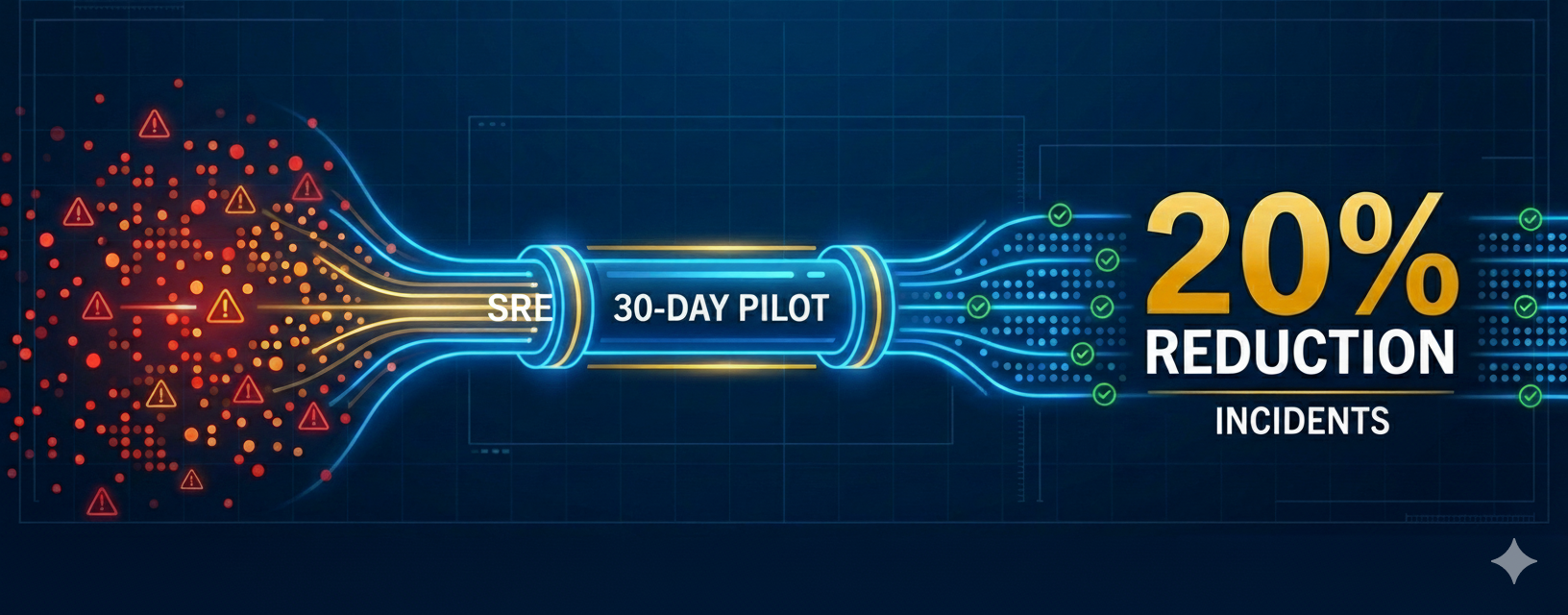
Three SRE Moves to Cut Incidents by 20%: A 30-Day Pilot
Small and mid-sized teams want reliability gains without heavyweight process. This 30-day pilot focuses on three Site Reliability Engineering (SRE) moves that consistently reduce incidents: meaningful Service Level Objectives (SLOs), disciplined error budgets, and tight postmortems. Each move is lightweight enough to fit alongside your current delivery cadence.
1) Pick SLOs That Actually Reflect Customer Pain
Start with two to three signals that matter for your users and your business.
- Availability: e.g., 99.5% over 30 days for core API (Application Programming Interface)/checkout flows.
- Latency: p95 < 600ms for key endpoints during peak hours.
- Error rate: 99% success on write paths; alert on sustained 1%+ errors.
Keep SLOs observable on dashboards. If you can’t see it, you can’t steer it.
2) Run on Error Budgets and Gate Risky Releases
Error budgets turn SLOs into operating limits. When a budget is burned, slow risk, not teams.
- Budget math: For 99.5% availability over 30 days, you have ~216 minutes of allowable error. Track burn-down.
- Release guardrails: If budget burn > 50% before mid-window, tighten change windows and require rollback plans.
- Decision rule: If burn > 80%, pause risky changes and focus on fixes until you re-enter budget.
Discuss budgets in weekly ops review; make trade-offs explicit across product, eng, and ops.
3) Blameless Postmortems That Actually Change Behavior
A good postmortem ships fixes to failure modes, not just root cause analysis (RCA) docs.
- Template: What happened, customer impact, detection gap, contributing factors, fixes with owners/dates.
- Timebox: 45 minutes, within 48 hours of the incident; ship at least one detection or guardrail improvement.
- Sharing: Publish to a single log; review top learnings in monthly ops forum.
30-Day Pilot Plan
- Week 1: Pick 2–3 SLOs, stand up dashboards, agree on the error-budget rule of engagement.
- Week 2: Instrument alerting for SLO breaches; run a tabletop on a recent incident using the new postmortem template.
- Week 3: Apply budget gating to at least one release; log one real postmortem with fixes.
- Week 4: Review outcomes: incidents, mean time to detect (MTTD), mean time to recover (MTTR), and change failure rate. Decide what to codify.
Metrics to Watch
- Incidents per week and MTTR.
- SLO attainment and error-budget burn rate.
- Change failure rate and rollback frequency.
- Detection coverage (alerts tied to SLO symptoms, not just infrastructure metrics).
Common Pitfalls
- Too many SLOs; start with a few that map to customer pain.
- Budgets without decisions; pre-commit to what you will slow when burn rises.
- Postmortems without action; require at least one shipped guardrail or detection fix.
Downloads
- SLO Starter Pack — Download
- Error Budget Tracker — CSV — Download
- Blameless Postmortem Template — Download
- Incident Communications Templates — Download
- 30-Day Pilot Checklist — Download
- Alert Design Cheatsheet — Download
- Metrics Quick Sheet — Download
- Release Guardrail Template — Download
- SLO Dashboard Wireframe — Download
- SRE & Observability Tools Guide — Download
Acronym Guide
- SRE — Site Reliability Engineering
- SLO — Service Level Objective
- API — Application Programming Interface
- RCA — Root Cause Analysis
- MTTD — Mean Time to Detect
- MTTR — Mean Time to Recover